Showing posts with label music. Show all posts

Tuesday, 27 December 2011

A new Christmas song

I'd like to introduce you to a brand new Christmas song, composed and performed by two very good friends who live in Norway: Edith Nilsberg and Orlando Ortiz.

Edith, a Cumbrian, and a gifted singer throughout her life, has composed the song, and after a couple of years during which her singing has taken a back seat, her voice is very much back on form with this new number.

The superbly talented Mr Ortiz does everything else: all the instruments, all the technical studio work. His easy ability on guitar is particularly noticeable here.

Together, they have produced a happy little song which should bring a smile to everyone's face.

I'm sorry it wasn't ready to upload until after Christmas, but it will still be here for you next year!

Click here to listen to Merry Christmas by Edith and Orlando


Saturday, 9 August 2008

Fringed

Since I had to be in Edinburgh anyway on the first weekend of August, I thought I'd see which Fringe music shows had already got started. Not many, if you look through the enormous programme. I sat in Hilary's kitchen thumbing through it: the first thing we fancied had been cancelled; the next couple were starting in about 10 minutes, leaving us no time to get there. We finally settled on something called Café Cadenza, described thus: "Eclectic wind virtuoso John Sampson and songwriting singer-guitarist Stewart Hanratty produce an hour of classy music, ranging from Stewart's contemporary tales to John's recorder, crumhorn and trumpet, creating a warm, forget-the-word atmosphere."

Well. Mention recorders and crumhorns and I'm yours. Hilary was inclined to agree, so we chucked the Fringe programme in the back of the car and set off. Halfway there, I said to Hilary, " It was at that place in Nicholson Street, wasn't it?" And Hilary replied, with absolute conviction, "No, no, that was the one we couldn't get to - this one's at the Carlton Hotel." "Are you sure?" said I, not at all sure myself now. "Positive," said Hilary. How could I argue with that?

The Carlton Hotel is not the sort of place you can get parked outside, so we parked away back up Nicholson Street and walked very fast down to the North Bridge, as the show would be starting quite shortly. Like most venues during the festival, the Carlton was festooned with a variety of Fringe posters. Hilary started following some people who looked like musicians, in through the front door of the hotel, through the lobby and down a back staircase. Like a sheep, I followed her, feeling the whole thing was somehow wrong. Eventually one of the musicians turned round and explained that although this was indeed the way to the venue, if we followed any further we'd end up on the stage with them, and we ought to go in through the other door.

Back up the stairs we trotted, somewhat faster than before, then out through the main door and back in through the side door, where a girl at a desk claimed she'd never heard of Café Cadenza. I borrowed her copy of the Fringe Programme (for ours was still lurking several blocks away in the back of my car) and discovered that, astonishingly, Hilary had been wrong, and the show was indeed in the venue, named for the duration, as, 'The Zoo, Southside,' back up the road in Nicholson Street.

We nearly ran this time, back up across the High Street, up Nicholson Street, past where I'd parked the car, and about the same distance in the opposite direction until we reached the old church where the show was about to start any moment.

"After all this," I thought, "it had better be bloody good."

We found a seat in a little room set up with 'cabaret seating' as they call it in the Kirkgate - tables, chairs and candles, with a few fairy lights draped around a red velvet curtain to provide a stage.

A man with a guitar appeared, propped up several strange paintings on a chair, and started to sing. I still have no idea what he was singing about as his enunciation wasn't too good, but the songs seemed to be connected in some way with the paintings, which we deduced he had probably created himself. I'm sure this would have been much more enjoyable had we been issued with sheets containing the lyrics - the songs were probably very funny, or sad, or thought-provoking, or profound, or just damn good poetry, but we'll never know.

Had it not been for the promise of recorders and crumhorns I'd have got up and left. I could think of several things I'd rather be doing in Edinburgh on a Saturday night. Suddenly, when I just thought I couldn't take any more, a big man with an interesting beard burst on to the scene playing a post horn with great enthusiasm, and from this point on the whole show livened up.

John Sampson (for it was he) is a skilled performer on a variety of wind instruments, which he plays with aplomb. He's also very funny, and one of those people with the ability to get a laugh with just the odd raised eyebrow. Stewart Hanratty, the guitarist, slipped easily into a role much better suited to him, that of accompanist, and between them they entertained us delightfully for three quarters of an hour.

Shame about those first 15 minutes, really.

If Mr Hanratty really must sing his songs, the least he could do would be to intersperse them throughout the show, in between John Sampson's instrumental pieces, though quite honestly, the whole thing would have been better without the songs at all. Sorry, Stewart.

Sunday, 24 February 2008

Snake Davies Woodwind workshop

Busy old week, this. Still recovering from Michael Schenker's gig last night, I find myself at the Rosehill Barn clutching Steve's lovely Martin alto sax and learning some tricks of the trade from Snake Davies, virtuoso jazz saxophonist/flautist.

I find the place full of our customers: mostly sax players, but a couple of flutes and a clarinet as well. I did toy with the idea of bringing one of my recorders, but decided it might be just a bit too radical, expecting such a thing to be accepted as a potential jazz instrument.

After too many years playing classical music from the dots, and folk music from memory (but sticking to the same tune all the time) I find it really hard to let loose and play solos based only a chord pattern. It's OK on a guitar - your fingers fall into the chord shape and all you have to do is play those particular notes in some random sort of sequence for it to sound like an interesting improvised solo, but on a wind instrument it's much harder. I tend to start off OK, and then get lost in whatever I've started playing, and by the time I'm halfway through I've completely lost track of which chord I'm supposed to be playing with. I guess practising occasionally might help . . .

Friday, 18 January 2008

John Codona, Edinburgh's one-man-band

When I was a little kid we used to get all sorts of people coming round the streets. There was the knife-sharpener with his big grinding wheel; there was Mrs Dunlop with her barrel-organ, pulled by Smokey the pony; there was Jeannie Livingstone the Musselburgh fishwife; there was the daily delivery of milk by St Cuthbert's horse-drawn milk wagons; and of course, there was John Codona, the one-man-band.

John was a member of the Codona family, who still to this day run fairground rides. They've been showmen for generations, probably going back at least to 1800 or beyond. A few members of the family moved sideways from the fairgrounds, and earned their livings doing what we'd now call busking, but in those days I guess you'd call them street performers. John spent his entire life playing in the street, a career lasting over 50 years.

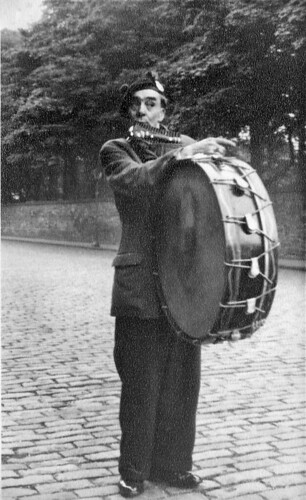
When I first saw him I believe he carried the full one-man-band equipment, complete with big bass drum attached to his back, full Highland bagpipes at the front, and on top of the drum various cymbals and things, operated by foot pedals. I think the bass drum was controlled by clapping his knees together. It was all very technical, and fascinated me as a child. I guess some of my earliest experiences of music came from him, and I'm sure my first hearing of many of the old Scots tunes came from his playing.

My parents, too, appreciated his skills. The tradition, when a street performer came round the Edinburgh tenements, was to wrap a few coins tightly in a scrap of silver paper, open the front window and drop this offering down to street level where the performer could pick it up. Our stair was 3 floors high (4 if you count the ground floor) and some in other parts of the city are much taller, so this was a sensible way of contributing, saving a long trip downstairs.

My father, as a keen photographer, got John to pose on a couple of occasions, first in black and white, and a few years later in colour. Interestingly, none of these photos shows his bagpipes, though I'm convinced he did play them. The earlier one shows him with the big drum on his front, and blowing a set of panpipes. If I remember correctly - and here, the photo backs me up - these weren't the sort of panpipes you can now pick up in ethnic crafts shops, as played by South American performers. I think each tube had its own fipple-type mouthpiece, similar to a penny whistle's. He holds the instrument straight out from his mouth, as you certainly would do if you were playing with that sort of mouthpiece. Andean panpipes have to be blown over the top, and would be held vertically.

Sadly, over the years, John's health gradually deteriorated, and he gradually had to give up carrying the bigger, heavier instruments. The black & white photo may have been taken when he had already given up the bagpipes, and the colour ones show him when he was reduced to just the one instrument.

It's this instrument that intrigues me at the moment. My dad always referred to it as a "chanter", and I'm pretty sure that's what John himself called it, though for the first time I find myself actually looking closely at the instrument in the photo, and this is no chanter. I'm sure I can see some sort of ligature at the mouthpiece end, as though it's holding on a reed in the style of a clarinet. My best guess would be a chalumeau, which is a short, simple type of clarinet that plays only the lower register. I've had suggestions that it might be a toy clarinet or an Ab clarinet; also it's possible that this, as well as the panpipes, was something created or adapted by the musical members of the Codona family as a usefully loud instrument for street performing.

You can see the bigger versions of these photos on Flickr at the following links:
Black and white photo
First colour photo
Second colour photo

I've had these photos up on Flickr for several months, and yesterday I had an email out of the blue from one Frank Bruce who is currently writing a book about the Codona family; during his researches he came across my photos. Of course I'm delighted to be able to let him use them in the book, with Thomas Morgan McGurk acknowledged as photographer (I'm sure he'd be proud). But the whole episode has got me asking questions about John's instruments and style of playing.

For instance, notice that he plays his woodwind instrument, whatever it is, with the right hand at the top and left at the bottom. I know that in the past there was no rule about which hand went where, but I sort of assumed that by the 20th century people had settled down to left at the top and right at the bottom. Apparently, though, this isn't quite true, and I've had all sorts of interesting anecdotes about hand positions.

Here's one from Jack Campin: "The oddest story like this I've heard was about John D. Burgess, who entered a Highland piping competition and after winning it asked the judges, "did you notice anything unusual?" - they hadn't, but about halfway through he'd turned round with his back to them while playing a high A and swapped his hands round on the chanter."

More exciting still, I now find that Jacey Bedford has a large collection of historical photos, which include a couple of John Codona, as well as some of Mrs Dunlop with her barrel organ and the Store Milk Cart! I await their arrival on Flickr with bated breath!

Tuesday, 1 January 2008

Hello 2008

Well, here we go - another year and still alive.

When I first moved to Cumbria from Scotland I couldn't believe anyone would be mad enough - no, I really mean sober enough - to go out morris dancing on New Year's Day. I grew up in a world where sensible people didn't emerge from the safety of their duvets until late afternoon. In England, New Year's Day is a bank holiday, and most people go back to work on the 2nd. In Scotland both the 1st and the 2nd are holidays. Even if they were supposed to go back on the 2nd, very few people would, so there's no point.

Anyway. I'm used to it now. It's a tradition now. We go out on New Year's day, meet up at a pub somewhere (yes, there's still a little drink involved) at about noon, and perform a few dances in the street outside before wandering back to someone's house for a bit of a party.

This year it was the Bush in Cockermouth Main Street. It rained, but the landlord refused to let us dance inside on the nice wooden floor in case it upset the 2 customers who were sitting there. Fortunately the rain eased off a bit so we were able, in the end, to dance outside.

It could have been a lot worse. Two years ago we danced at the Theatre by the Lake, Keswick, on New Year's Day, and the rain practically washed us away (see photo, left).

So, everything seemed to be going nice and smoothly. We all sloped off to Susie's house for food and wine and good conversation. Two of Bridget's beautiful granddaughters (they have 5 - so far!) were there too, one aged 6 and the other 2½.

Phil got talking about his electric guitar, and before we knew it we'd all got our instruments out - my guitar emerged from the car, Bridget's accordion, Gin's concertinas (she's got a new one for Christmas too), Pete's bouzouki, and Chiara joined in with her shakers. There were probably more songs than usual along the lines of The Wheels of the Bus or The Bear went over the Mountain, but we managed some grown-up stuff too and everyone had fun.

It wasn't until I was on my way home, driving up the really wiggly, narrow, dark bit of the road between Dearham and Crosby, that I noticed the regular thumping noise from under the car somewhere. Not the best place in the world to stop, on a nearly-single-track road in the pitch dark where drivers are trying to negotiate several tricky bends, so I crept gingerly along until I got to the lights of Crosby and found a safe place to stop.

We'd just had a leaky tyre recently, so my first thought was that the spare, which Steve had put on the other day, was also leaky and had gone flat, but it looked OK. Couldn't see anything obviously wrong, but the thumping sounded serious and worrying, so I heaved both the sax and the guitar out of the back, strapped them on to my back, and trekked homewards on foot. (Not as bad as it sounds - something like a 10-minute walk.)

Having changed into old clothes at home I brought Steve back to look at it, and eventually we discovered that the spare wheel had started coming loose. Oops. Just as well I drove slowly on it! I shall go see the nice man at KwikFit tomorrow.

I was once, many years ago, in the passenger seat of a car whose nearside front wheel decided to make a break for independence, and funnily enough, it was also on New Year's Day, though it would have been the year when I was about 19 or 20, and before I had a car of my own. Hilary had a mini (a proper mini - the original sort) and like all her cars in those days it was old and battered and, had the MOT test been invented then, would almost certainly have failed.

We were driving along Bucchleuch Street when I pointed out to her that there was something - oh, yes, it looked like a wheel - rolling along the road in front of us. Casually we both wondered where it had come from, and then the car seemed to realise something was missing and went, THUMP! SCRAPE! and sort of collapsed at the front left hand corner. The wheel, released from the burden of being attached to a heavy car, went rolling merrily off down the road, and we had to run after it to retrieve it once we realised it was ours.

Well, that's enough excitement for one day. I'll be glad to get back to work.

Sunday, 30 December 2007

Nothing happened today . . . ?

I used to keep a diary when I was a kid. A page to a day, it always was, and at the start of each year I'd busily fill in everything that happened over the course of a day. Some days were full of things and others read something like this: " Got up. Had breakfast. Went to school. Came home. Did homework. Went to bed."

By the time February came along, those sort of days had degenerated into: "Nothing happened today." And by the beginning of April, most days would be completely blank. If a lot was happening in my life, I was too busy to write it down, and if nothing much was happening, I couldn't see much point in writing, yet again, "nothing happened".

Somewhere in the attic there's a box full of such diaries. Fully documented Januarys and Februarys, skimpy springs, and a big blank space for the rest of the year. Occasionally I'd write up my diary when we went on holiday, as there was no homework to do, and probably no TV to watch either, but other than that . . .

But is a blog the same as a diary? Probably not. And in those childhood diaries I suspect I had the wrong approach, anyway. It doesn't have to be a description of what you did all day, does it?
(Today - took the dogs for a walk in a waterlogged field; went to Sainsbury's; visited Steve's dad; watched yet more old episodes of Friends; read graphic novel; got legs squashed by heavy cat.)

So what is a blog for? Sharing my opinions with a largely uninterested world? Proving some sort of point? I really don't know. Why am I doing this? Um . . .

OK, here's a question: Is there any point in my arranging Charlie Chaplin's theme from Limelight for recorder quartet? Oh, wtf, I'll do it anyway. It's fun.